Readiness & the runbook
One verdict — go, caution or not ready — across your fleet, and the runbook that gets you there.
What it's for
Before a sale opens you want one answer per Account, and one for the whole fleet: ready, or not. Readiness turns "am I ready?" into an ordered runbook and a single verdict, so you're not eyeballing twenty Sessions with the clock running.
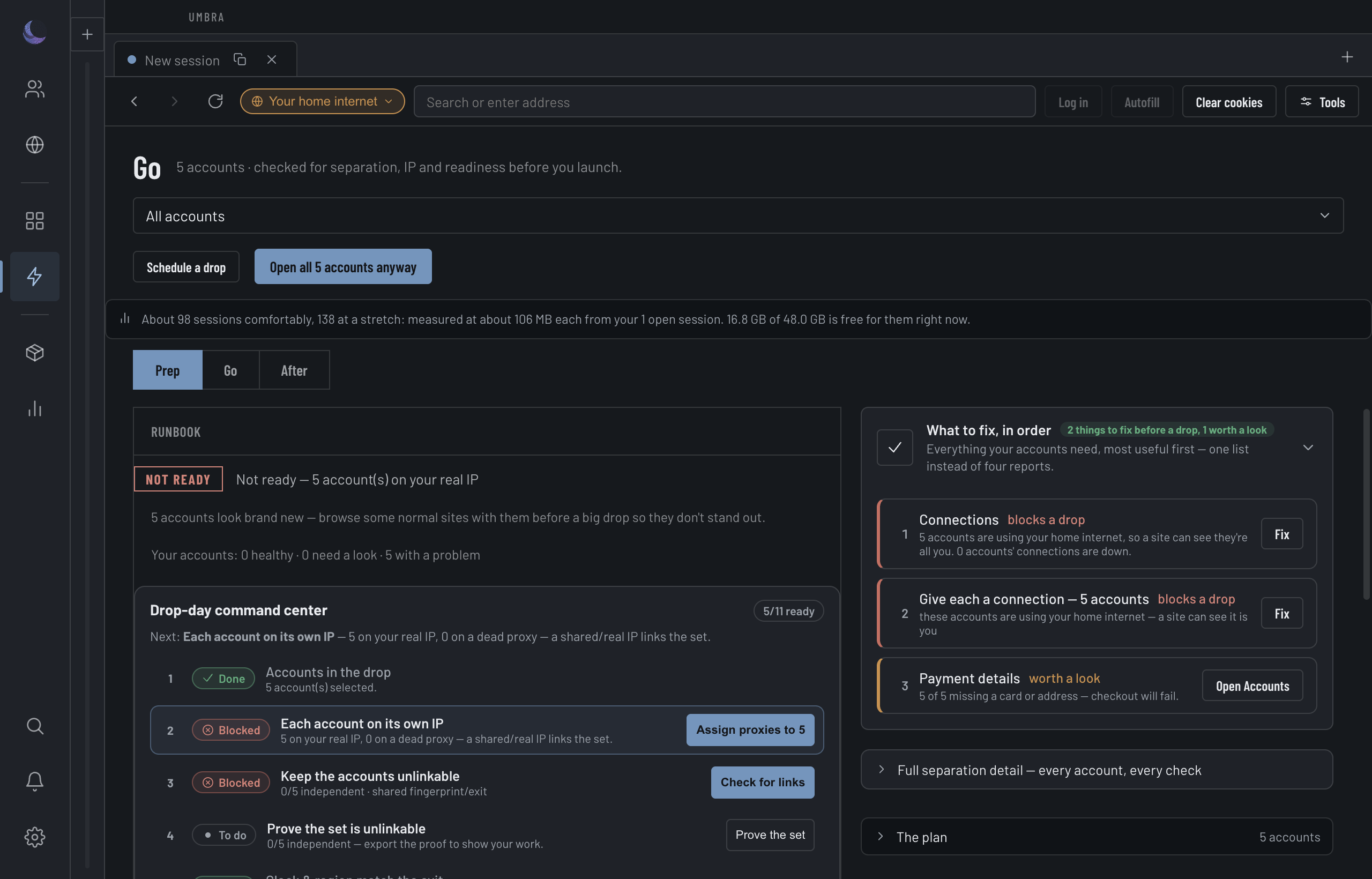
The verdict
Every check rolls up into one of three words.
An unrun check is caution, never go — Umbra won't grade something it hasn't measured as if it had passed.
Run the pre-flight
The runbook walks the same order every time. Work top to bottom and the verdict turns over as you go.
Warm the Accounts
Age each Account and keep its state, so it doesn't look brand-new at checkout.Test the exits
Every Account needs a healthy, tested exit — that test is also what aligns its clock and locale. See Proxies.Run the separation report
Check the fleet for the ways Accounts can be linked to each other. See the Separation report.Measure the open Sessions
Open the Accounts you'll run and measure them — this is what turns the exit and WebRTC checks from "unknown" into a real reading (see below).Clear the fix queue
Work each finding until the verdict is green.What actually blocks a drop
Not every link stops you. Three checks turn the verdict red: Proxies — an Account with no exit (still on your real IP) or a dead one; Anti-Linkage — an identical Fingerprint shared by two Accounts, a shared exit, or a shared payment label; and the opt-in WebRTC check. A shared subnet or a shared shipping address surface on the board but don't gate the verdict.
The WebRTC check is opt-in
This is the one to read twice. WebRTC can surface a real IP even when your traffic is on an exit. Umbra applies a hardened WebRTC policy and can measure whether it actually held — but the blocking part of that check only engages once you measure.
Fix what it finds
Every finding in the queue carries its own one-click fix. De-link moves an Account off a shared exit onto a clean one; realign re-syncs a drifted clock; a missing-exit row assigns one. Work the queue, re-measure, and the verdict follows.