What the fleet audit checks — and what "clean" actually means.
What it's for
The Separation report is the fleet-wide answer to the one question the whole product turns on: could a ticket site tell your Accounts apart, or would it tie two of them together and ban the set? It reads every Account against every other, surfaces the ways two could be linked — a shared Fingerprint, a shared exit, a reused card — and puts a one-click fix on each.
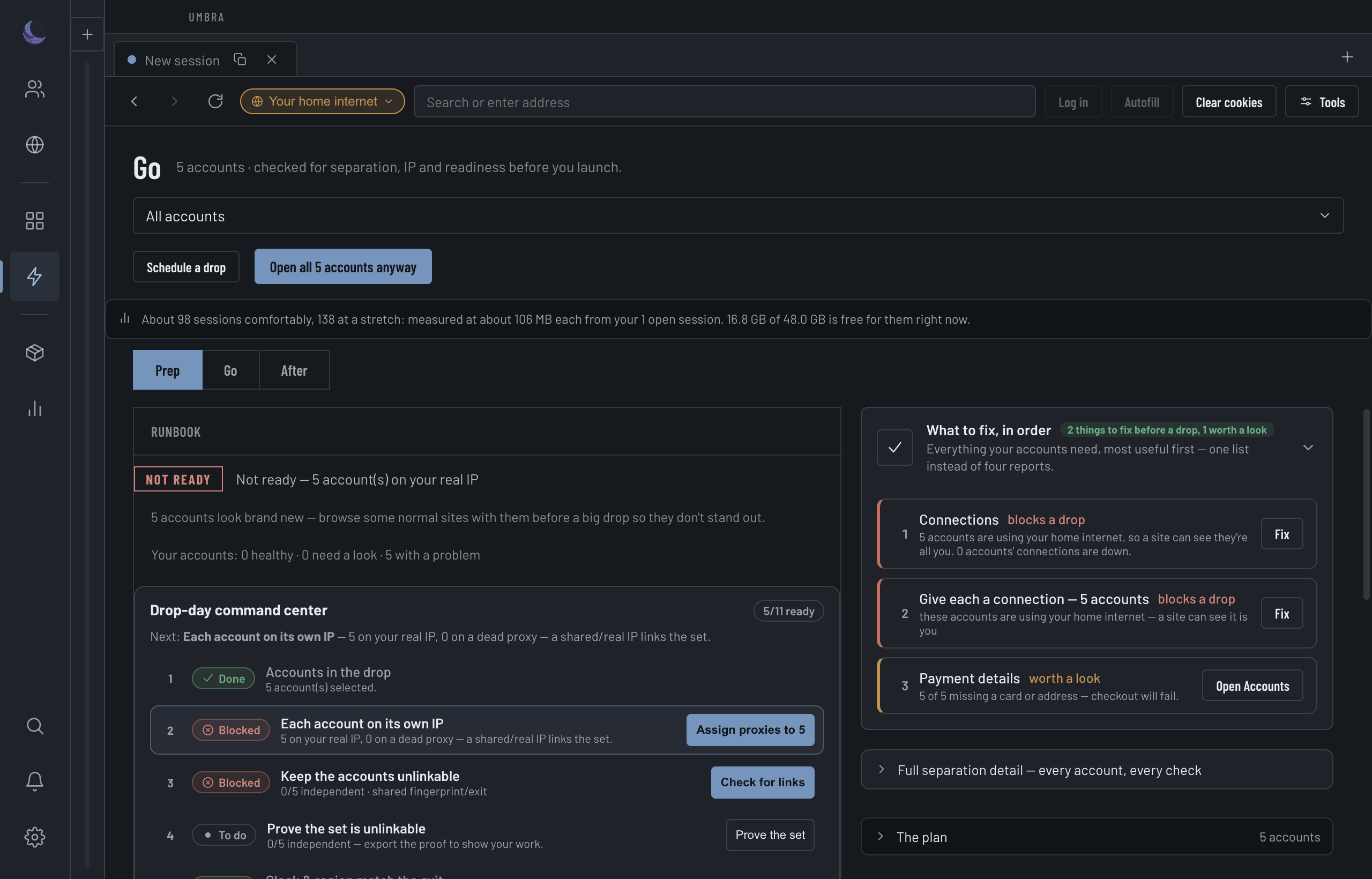
Read it in the pre-flight, before a sale opens (it's step three of the drop-day runbook). It lives on Go → Prep, under Full separation detail.
Six Accounts, several links: the board reads 3 of 6 genuinely independent and names every one.shot-go · 6 accounts — 2 sharing one exit, an identical-fingerprint pair, 2 with no exit → board reads 3/6 genuinely independent, severity chips, a link list with fix buttons
The independence score
The headline is a single count — how many of these Accounts sit in no link group at all. "3 of 6 genuinely independent" means three Accounts the audit could find no link for; the other three collapsed into one link or another, shown as severity chips beneath.
Read it as exactly what it is: a count of Accounts nothing linked, not a proof that they are unlinkable. An Account is "independent" here only across the axes the report actually compared — which is the catch the last section is about.
The six links it looks for
Each check groups Accounts on one field and flags any group of two or more that share it.
Identical fingerprint
Two Accounts share a canvas/audio seed — to a site they are literally the same device. High.
Shared exit
Two Accounts come out at the same address — the same proxy, or two proxies that resolve to one exit IP. To a site, one visitor. High.
No connection — home internet
Two or more Accounts with no exit assigned at all: every one of them browses from your real machine IP. High.
Same subnet
Different exits, but inside the same /24 — a softer household/ISP tell than a shared address. Medium.
Shared payment
Two Accounts carry the same card label. Payment reuse is the number-one cross-account linking vector. High.
Shared shipping
Two Accounts deliver to the same address label. Medium.
Below the links sit two per-Account roll-ups: incoherent Fingerprints (an Account that fails its own coherence lint) and clock / region mismatches (a proxied Account whose clock contradicts its exit region). Those are single-Account faults, not cross-Account links — clearing them is covered in Fixing links.
What blocks a drop, and what only warns
Not every link stops a sale. Three hard links turn the drop verdict red; the softer three surface on the board but don't gate it.
"Uncompared" is not "clean"
This is the sentence to read twice. Every check groups Accounts on one field — a seed, an exit IP, a card label. An Account that doesn't carry that field is dropped from the grouping before the comparison even runs: it isn't cleared on that axis, it's simply absent from it.
Clearing what it finds
Every link on the board carries its own one-click remedy — re-roll, de-link, or distribute a distinct label — and the two roll-ups carry realign. How each one works, and where a fix can only partly land, is Fixing links.